Microsoft 365 Copilot gets an AI Researcher that everyone will love
Microsoft is late to the party, but it is finally bringing a deep research tool of its own to the Microsoft 365 Copilot platform across the web, mobile, and desktop. Unlike competitors such as Google Gemini, Perplexity, or OpenAI’s ChatGPT, all of which use the Deep Research name, Microsoft is going with the Researcher agent branding.
The overarching idea, however, isn’t too different. You tell the Copilot AI to come up with thoroughly researched material on a certain topic or create an action plan, and it will oblige by producing a detailed document that would otherwise take hours of human research and compilation. It’s all about performing complex, multi-step research on your behalf as an autonomous AI agent.
Just to avoid any confusion early on, Microsoft 365 Copilot is essentially the rebranded version of the erstwhile Microsoft 365 (Office) app. It is different from the standalone Copilot app, which is more like a general purpose AI chatbot application.
How Researcher agent works?
Underneath the Researcher agent, however, is OpenAI’s Deep Research model. But this is not a simple rip-off. Instead, the feature’s implementation in Microsoft 365 Copilot runs far deeper than the competition. That’s primarily because it can look at your own material, or a business’ internal data, as well.
Instead of pulling information solely from the internet, the Researcher agent can also take a look at internal documents such as emails, chats, internal meeting logs, calendars, transcripts, and shared documents. It can also reference data from external sources such as Salesforce, as well as other custom agents that are in use at a company.
“Researcher’s intelligence to reason and connect the dots leads to magical moments,” claims Microsoft. Researcher agent can be configured by users to reference data from the web, local files, meeting recordings, emails, chats, and sales agent, on an individual basis — all of them, or just a select few.
Why it stands out?
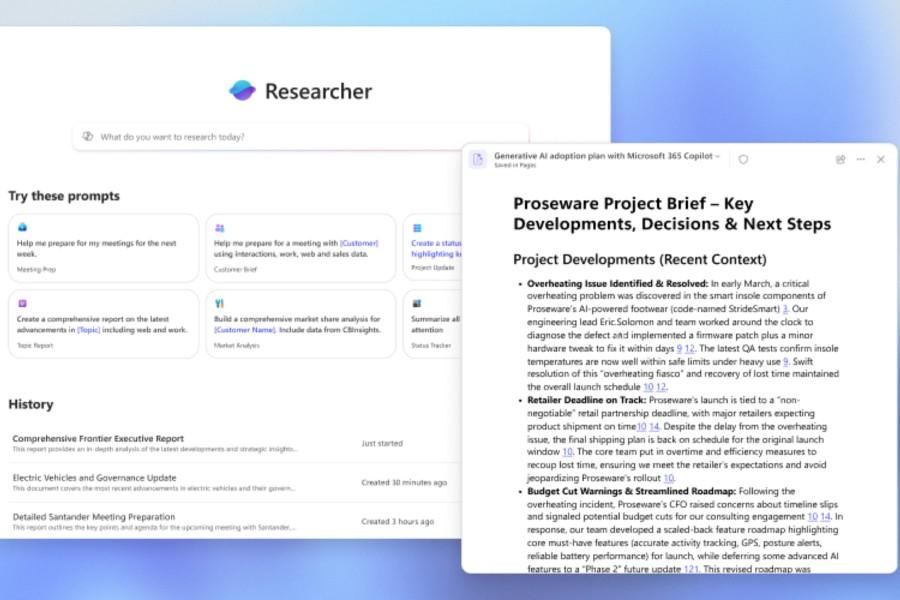
The overall idea is to create a research tool that can create detailed plans on external data available on the web, as well as the internal company material. For businesses, that’s a huge relief. Microsoft already has tens of thousands of enterprises that have created their bespoke AI agents to automate internal work using the Copilot Studio tool.
“It leverages the enterprise knowledge graph to integrate user and organizational context, including details about people, projects, products, and the unique interplay of these entities within the user’s work,” says the company. During early tests, Microsoft claims the Researcher agent saved 6-8 hours on a weekly basis for selected adopters.
Access to Researcher will first start rolling out to Microsoft 365 Copilot customers in April. It will be released as part of a new Frontier program that gives early access to new Copilot tools, somewhat like the Insider Preview program for beta testing Windows OS.







Comments on "Microsoft 365 Copilot gets an AI Researcher that everyone will love" :